




close

Sound Pedagogy

AssignmentsField RecordingsResearchSonic GeographiesSound MapSound PedagogySound Theory

Listening for Justice: Sound, Place, and Environmental Inequality

Border Soundscapes Sunsets

Assignment Description:

This critical and creative assignment asks you to explore how sound reveals the often-overlooked connections between environmental injustice and lived experience. You will begin by listening deeply to a space impacted by environmental harm or inequality—this could be due to noise pollution, industrialization, gentrification, racialized neglect, or lack of green space. Through this process, you will reflect on how sound and listening practices can expose, resist, or even help transform environmental injustice.


read more
AssignmentsField RecordingsResearchSonic GeographiesSound MapSound Pedagogy

Sonic Borderlands Digital Project. Mapping the Sonic Border: A Digital Exploration of Sound, Space, and Identity

11062b_f02e0adb7c3f4bdc89b8cc8ace5c5630~mv2

Assignment Description

This culminating assignment invites students to synthesize theoretical, practical, and experiential learning into an original digital project. Drawing from the course themes—borders, identity, migration, power, and sound—students will conceptualize, design, and produce a Sonic Borderlands digital project that explores the intersections between sound and border discourses.

read more
AssignmentsSonic GeographiesSound MapSound PedagogySound Theory

Cultivating a Culture of Listening: Mapping Sound in Community Research

f891dd4f93494dee9a9bc8aabd6525d1

Introduction

While traditional maps offer visual representations of location data, Mapping Sound provides alternative insights by engaging multiple senses. These maps assign sounds to specific data points, aiding information delivery and unveiling nuanced community details. Rodaway’s (1994) concept of sonic geography describes how sound delineates physical landscapes and encapsulates socio-economic exchanges, offering a theoretical foundation for this sensory-based mapping approach. In this practice, you will explore the Mapping Sound method as part of Sonic Rhetorics. This tool aims to cultivate a culture of listening within community research projects, particularly focusing on integrating sound dimensions into research essays addressing community-based issues. Through this assignment, you will deepen your understanding of sound’s impact on communities and develop a greater sensitivity to listening in the research process.

read more
ArtBlogExperimentalField RecordingsIdentityMusicResearchSonic GeographiesSound PedagogySound Theory

Deciphering Sounds

Soundboard

“The U.S.-Mexican border es una herida abierta where the Third World grates against the first and bleeds. And before a scab forms, it hemorrhages again, the lifeblood of two worlds merging to form a third country—a border culture.”

This quote embodies the profound metaphorical understanding of the border as a wound, a space of constant friction and intersection between cultures. Anzaldúa’s perspective captures the complexity and struggle of living within and between multiple worlds, resonating with the sonic landscape and the multitude of sounds that encapsulate this border culture.

Soundscapes transcend border divisions; they encompass and traverse cities naturally, reaching beyond arbitrary limits. Exploring the identity voice of the border becomes crucial. Many sounds that once echoed are now impossible to capture directly through field recordings. Some sounds can only be preserved through the efforts of individuals who seek to immortalize the essence of things or places over time. Take, for instance, the Rio Bravo. Its thunderous resonance from years past earned it the name “Bravo,” though cartographically labeled as the Rio Grande. Along the Juarez-El Paso border, this river no longer echoes as robustly, nor does it remain ‘Grande’. Its sound, a heritage lost, resides solely in the tales of our ancestors, a fleeting memory slowly fading, much like the once-majestic sound of the Rio Bravo.

The drive to investigate soundscapes stems largely from the avenues it opens when viewed through a rhetorical lens—an interdisciplinary field intersecting phenomenological explorations within the philosophy of sound. Sound studies manifest as an interdisciplinary field, spanning the humanities and social sciences, engaging collaborators from sociology, cultural and media studies, anthropology, cultural history, philosophy, urban geography, and musicology, offering boundless possibilities. However, to comprehensively understand, it’s vital to detail what Soundscapes entail.

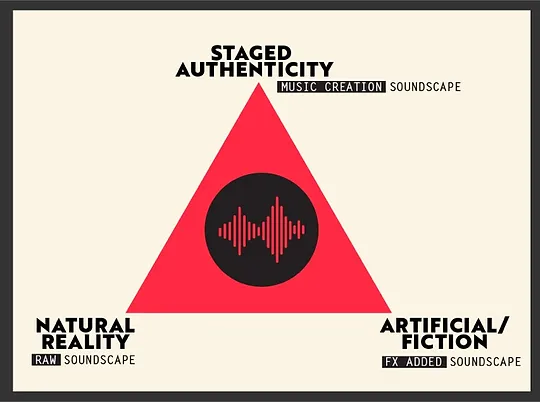
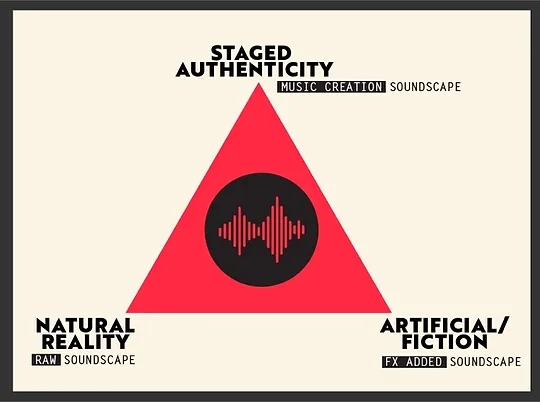
Murray (1997) introduces the concept of Soundscape, a fusion of Sound and Landscape. He defines soundscape as the documentation or capture of an acoustic environment’s sounds. His proposal extends beyond mere audio production, delving into acoustic ecology. Murray underscores the changing soundscape of the world, signaling humanity’s shift toward inhabiting vastly different acoustic environments. This concerns the pollution of sonic spaces and the clamor within diverse habitats. Murray asserts that all sound embodies a soundscape, categorizing every facet of the sonic environment as a field worthy of study.


The soundscape of the US-Mexico border is a symphony of cultural amalgamation, echoing the diversity and complexity of this region. It’s a tapestry woven with the rhythms of languages merging, music intertwining, and narratives colliding. Here, the resonance of footsteps on both sides speaks of shared journeys and unique struggles. The rustle of desert winds carries whispers of hope and hardship, while the languages spoken paint a vivid portrait of heritage and resilience. This auditory landscape is not merely noise but a living testament to the vibrant coexistence of identities, where every sound, from the bustling streets to the tranquil river flow, narrates stories of resilience, adaptation, and the unyielding spirit of a borderland community.

read more